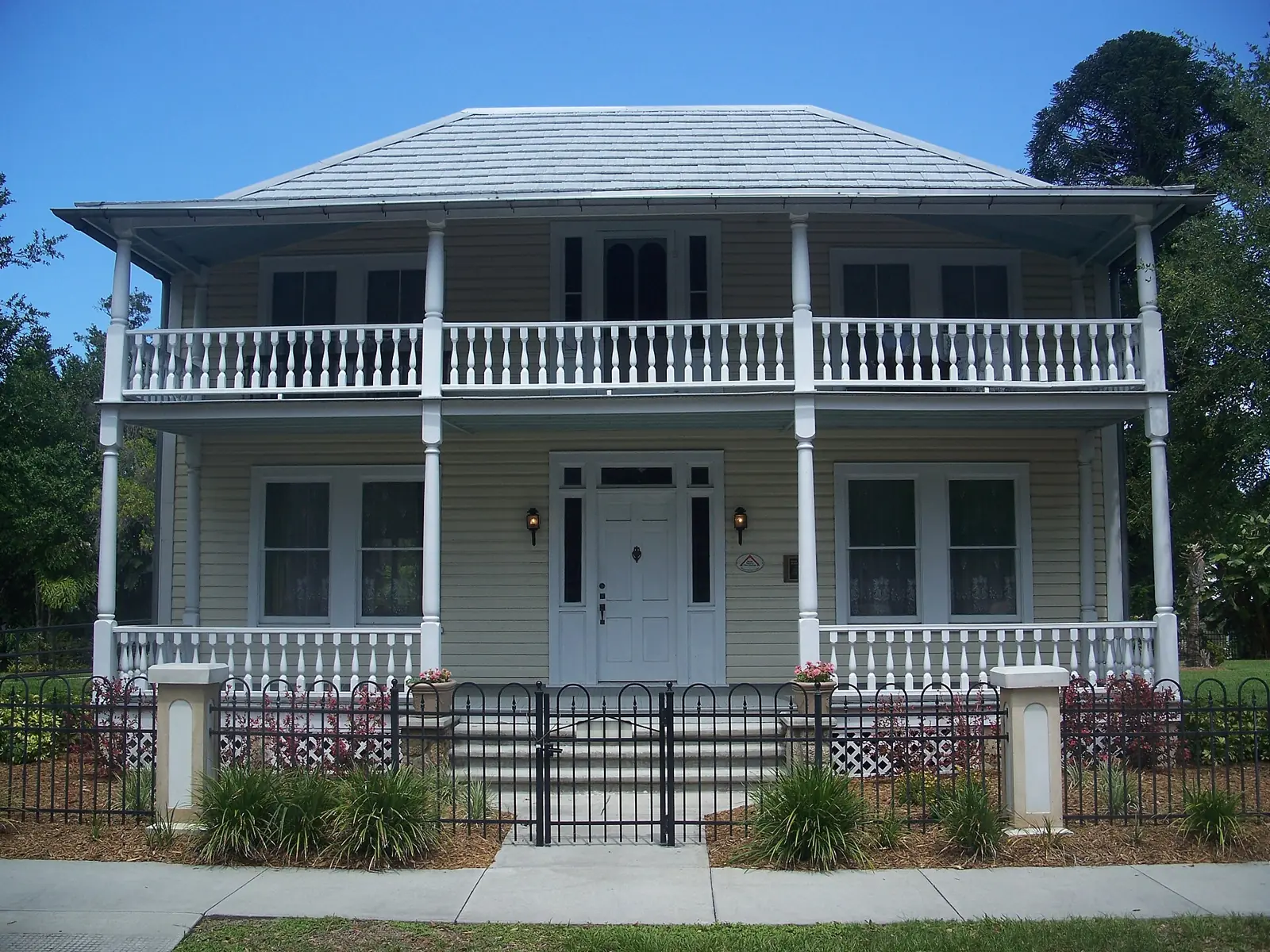
Melbourne was named in 1880, incorporated in 1888 and merged with Eau Gallie in 1969. Its four National Register sites, museums, markers and cemeteries.
Last checked Oct. 9, 2026. Sources: the National Park Service’s National Register of Historic Places listed-properties file (May 22, 2026); the Florida Division of Historical Resources’ historical marker program; the City of Melbourne’s Historic Preservation, About the City, Fire Department history and cemeteries pages; the Rossetter House Museum; and the Genealogical Society of South Brevard’s “Olde History of Melbourne” by Weona Cleveland. The city’s website has no history page of its own.
Today’s City of Melbourne is two old river towns joined together: Melbourne, which grew up along Crane Creek, and Eau Gallie, near where the Eau Gallie River meets the Indian River. The two merged in 1969. The city now covers 51.56 square miles on both sides of the Indian River Lagoon.
Visit
- Rossetter House Museum: 1320 Highland Ave., 321-254-9855; tours Wednesday to Saturday
- Green Gables: 1501 S. Harbor City Blvd.; Saturday open houses in October 2026
- City cemeteries office: 2895 Harper Road, 321-608-7470, by appointment, 8 a.m. to 3 p.m. weekdays
- Historic preservation questions: Community Development, 321-608-7500
How Melbourne began
From Weona Cleveland’s history for the Genealogical Society of South Brevard:
- About 1870-1872: the earliest permanent settlers of the Crane Creek area, three Black men, Peter Wright, Balaam Allen and Wright Brothers, arrived. Portraits of the three now hang in the City Hall lobby; see our story on the founders portraits unveiled Oct. 13.
- 1874-1878: the Clohecy, Bradley and Richard W. Goode families followed, and C.J. Hector arrived from Australia in 1878.
- 1880: the first post office opened. The Goodes and Hector drew straws among Fountainhead, Villa Ridge and Melbourne. Melbourne won, honoring the Australian city where Hector had lived.
- 1883: the first schoolhouse was built, and Dr. William M. Fee, Melbourne’s first doctor, arrived.
- 1885-1886: the first church, Allen Chapel A.M.E., was built in 1885, then Holy Trinity Episcopal Church in 1886.
- 1888: the town was incorporated.
- July 1893: the Jacksonville, St. Augustine and Indian River Railway reached Melbourne.
The state’s Holy Trinity marker adds that the congregation organized in 1884 and its first church stood south of Crane Creek; members from the north side arrived by boat and, after 1895, by footbridge.
Eau Gallie
According to the Rossetter House Museum, Eau Gallie was founded in the 1850s around farming ventures including sugar cane, rice and citrus, and by 1893 it was the southern end of Henry Flagler’s Florida East Coast Railway. The museum says the Houston family homesteaded there in 1859 and called the place Arlington, later renamed Eau Gallie. In 1908, when James Rossetter built his home on Highland Avenue, the town had about 200 people.
The two towns organized volunteer fire departments in 1916. In 1969, “the City of Eau Gallie and the City of Melbourne merge to form one unified city under the name City of Melbourne,” the city’s Fire Department history records.
Industry and war
- Union Cypress Co. was “Melbourne’s first big industry,” according to a state marker at 2729 Lipscomb St. Its sawmill’s power plant supplied Melbourne’s first electricity, and its 18.5-mile railway to Deer Park (marker) was the first direct route across the St. Johns River for 80 miles south of Enterprise. The big mill burned in August 1919.
- Naval Air Station Melbourne was commissioned Oct. 20, 1942, at the Melbourne Municipal Airport and closed Feb. 15, 1946. More than 2,200 Navy and Marine pilots trained there in Wildcat and Hellcat fighters, the state marker says; 63 died in aerial accidents.
On the National Register of Historic Places
The National Park Service’s May 2026 file lists four properties in Melbourne:
| Property | Address | Listed |
|---|---|---|
| Florida Power and Light Company Ice Plant | 1604 S. Harbor City Blvd. | Nov. 17, 1982 |
| William H. Gleason House | 1736 Pineapple Ave. | Jan. 25, 1997 |
| James Wadsworth Rossetter House | 1328 Houston St. | July 27, 2005 |
| Green Gables | 1501 S. Harbor City Blvd. | May 18, 2016 |
Nearby listings outside the city include the Melbourne Beach Pier (1984) and the Community Chapel of Melbourne Beach (1992) in the Town of Melbourne Beach.
Local historic designations
Since 2006 the city has locally designated six historic resources and one district, its Historic Preservation page says. They include the Eau Gallie Yacht Club (1149 Houston St.), the Sea Lounge (105 E. Avenue B), 1393 Pineapple Ave., 509 Palmetto Ave., the Rossetter House and 418 E. New Haven Ave., plus the Eau Gallie Historic District along Highland Avenue, Houston Street and Montreal Avenue. Exterior changes to designated buildings need a Certificate of Appropriateness, which is free.
Museums, markers and cemeteries to visit
- Rossetter House Museum, run by the Florida Historical Society and the Rossetter House Foundation: the 1908 Rossetter House and gardens, the 1901 William R. Roesch House and the Houston family cemetery, established in 1865, half a block south. Tours of about 1.5 hours start at the Roesch House, 1320 Highland Ave., Wednesday through Saturday at 10 a.m., noon and 2 p.m.; 24 hours’ notice is required. 321-254-9855. (Visit page)
- Green Gables, 1501 S. Harbor City Blvd.: Saturday open houses 10 a.m. to 2 p.m. through Oct. 31, 2026, for a $10 donation, run by Historic Riverview Village, Inc. See things to do this month.
- State historical markers in the city include Holy Trinity Episcopal Church, the Rossetter House, Union Cypress Sawmill and Naval Air Station Melbourne; search them on the state’s marker site.
- City cemeteries: Melbourne Cemetery, 710 E. Hibiscus Blvd., and Eau Gallie Cemetery, 992 Masterson St. The cemetery office is at 2895 Harper Road, 321-608-7470.
What this means for you
- Walk the Eau Gallie Historic District on Highland Avenue, then tour the Rossetter House.
- Own an old building? Ask Community Development about local designation; it costs nothing.
Related: things to do this month, parks and trails and Melbourne population and growth.
Frequently asked questions
How did Melbourne, Florida, get its name?
When the first post office opened in 1880, settlers drew straws among Fountainhead, Villa Ridge and Melbourne. Melbourne won, honoring the Australian city where postmaster C.J. Hector had lived, according to the Genealogical Society of South Brevard.
When was Melbourne, Florida, incorporated?
In 1888, according to local historian Weona Cleveland’s history published by the Genealogical Society of South Brevard. Melbourne and the City of Eau Gallie merged into one city in 1969.
What are the historic places in Melbourne, Florida?
Four Melbourne sites are on the National Register of Historic Places: the Florida Power and Light Company Ice Plant (1982), the William H. Gleason House (1997), the James Wadsworth Rossetter House (2005) and Green Gables (2016).
Can you tour the Rossetter House in Melbourne?
Yes. Guided tours of about 1.5 hours run Wednesday through Saturday at 10 a.m., noon and 2 p.m., with 24 hours’ notice. They start at the Roesch House, 1320 Highland Ave. Call 321-254-9855.
Have your say